 11
11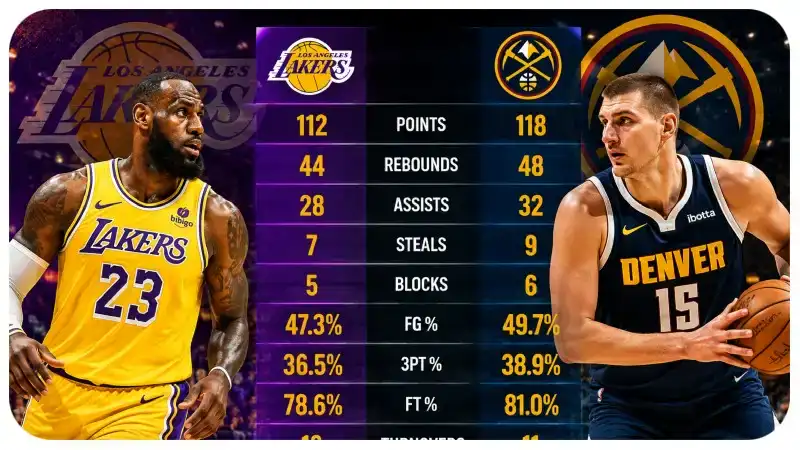
The Lakers vs Denver Nuggets Full Match Player Stats give fans a closer look at how individual players shape the game. A final score tells only part of the story. Points, rebounds, assists, steals, blocks, shooting efficiency, and turnovers help explain why one team gains an edge.
When reviewing Lakers vs Denver Nuggets Full Match Player Stats, it is important to look beyond the highest scorer. A player who creates open shots, controls the boards, or defends a key matchup can have a major impact without leading the scoring chart.
A matchup between the Los Angeles Lakers and Denver Nuggets often features several statistical battles. Both teams can rely on star talent, strong playmaking, and different offensive approaches.
Points usually attract the most attention on a box score. However, the total does not tell the complete story.
Look at field-goal percentage, three-point shooting, and free-throw attempts alongside points. A player who scores 25 points on efficient shooting may have a bigger offensive impact than someone who scores the same amount on many attempts.
For the Lakers, scoring can come from multiple positions. Denver can also spread the scoring load depending on the matchup and game plan.
Rebounding often decides which team gets extra possessions.
Offensive rebounds create second-chance opportunities, while defensive rebounds help a team finish possessions. When comparing the Lakers vs Denver Nuggets Full Match Player Stats, total rebounds and offensive rebounds deserve special attention.
Big men usually collect many boards, but guards also play an important role. Strong team rebounding can prevent fast-break chances and limit an opponent’s second shots.
Assists show how effectively players create opportunities for teammates.
A high assist total often points to good ball movement, but the overall passing picture matters too. Potential assists, secondary assists, and turnovers can provide additional context when available.
Denver’s offense can create difficult defensive decisions through passing and movement. The Lakers can also generate strong looks when their primary ball handlers attack the defense and find open teammates.
The best way to understand a player’s performance is to review several categories together rather than focusing on one number.
| Stat | Why It Matters |
|---|---|
| Points | Measures scoring production |
| Rebounds | Shows control of missed shots |
| Assists | Tracks direct playmaking |
| Steals | Highlights defensive activity |
| Blocks | Measures rim protection |
| Field Goal % | Shows shooting efficiency |
| 3-Point % | Measures outside shooting |
| Free Throws | Shows scoring at the line |
| Turnovers | Tracks lost possessions |
| Minutes | Shows how much the player contributed |
Shooting percentage can tell a different story from raw scoring totals.
For example, a player may score 20 points while making a high percentage of his attempts. Another player might score 24 but need many more shots. Effective field-goal percentage and true shooting percentage can provide even more useful context when those figures are available.
Three-point shooting also matters in modern NBA games. A strong night from beyond the arc can quickly change the flow of a close matchup.
Defense does not always appear clearly in a traditional box score.
Steals and blocks are easy to count, but good defense also includes contests, positioning, communication, and forcing difficult shots. A player can make a major defensive contribution without recording a steal or block.
When studying the full stats, consider how each player performed against the opponent’s primary scorers and playmakers.
Turnovers can swing momentum quickly.
A team that protects the ball gives itself more chances to score. Turnovers can also create transition opportunities for the opponent. That makes the turnover margin an important part of the overall game analysis.
Start with the team totals. Compare points, rebounds, assists, turnovers, and shooting percentages.
Next, review individual players. Identify the leading scorers, top rebounders, and players who recorded the most assists. Then check efficiency and turnovers.
Finally, consider minutes played. A player who logs heavy minutes carries a different workload from someone who plays a short stretch.
This approach gives fans a clearer picture of the game instead of relying on a single headline statistic.
Player statistics can reveal how a game developed.
If one team shoots efficiently but loses the rebounding battle, second-chance points may explain part of the difference. If a team records more assists while committing fewer turnovers, its offensive execution may have been stronger.
A strong individual performance also does not always guarantee a win. Basketball remains a team sport. One player can dominate the scoring column while the opposing team wins through balanced production and better defense.
That is why Lakers vs Denver Nuggets Full Match Player Stats should always be viewed alongside team statistics and the final result.
Head-to-head statistics can help fans understand how the Lakers and Nuggets respond to each other’s strengths.
For example, a team may focus on limiting three-point attempts, protecting the paint, or forcing the opponent’s stars into difficult shots. Player numbers can show whether that strategy worked.
Stats can also help identify players who quietly influenced the game. A reserve who scores efficiently, grabs key rebounds, or provides strong defense may become an important factor even without a huge scoring total.
The Lakers vs Denver Nuggets Full Match Player Stats provide much more than a list of numbers. They help explain scoring efficiency, rebounding, playmaking, defense, and overall team execution.
For the clearest analysis, compare points with shooting efficiency, assists with turnovers, and rebounds with second-chance opportunities. Looking at the complete box score gives fans a more accurate picture of who performed well and how the game was won or lost.
For more information, visit our site daily.